
Liberty Pumps
SJ10
$206.92
Pros & Cons
Pros
Cons
At a Glance
Overview
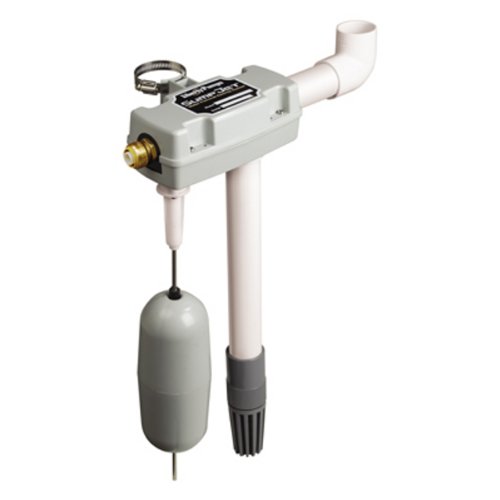
The Liberty Pumps SJ10 SumpJet is the answer to a specific problem: your primary sump pump is only as good as the power feeding it. When a storm knocks out electricity — which is exactly when your pit is filling fastest — a $500 primary like a Zoeller M53 or Wayne CDU980E becomes a paperweight. Battery backups like the Basement Watchdog BWSP cover that gap but come with their own anxiety: finite runtime, batteries that need replacing every few years, and chargers that fail quietly. The SJ10 removes all of it. It runs on your municipal water supply, needs no electricity at all, and at $206.92 it costs less than most quality battery-backup kits before you even add the battery.
The design is almost aggressively simple. A float-actuated valve opens when pit water rises past the activation point, municipal water rushes through a Venturi nozzle, and the resulting suction pulls sump water out through the discharge. There is no motor, no impeller spinning, no capacitor to fail — just physics and water pressure. Liberty rates the unit to remove two gallons of sump water per gallon of supply water, and the published performance chart shows anywhere from 660 to 1,185 GPH depending on your inlet pressure and lift.
The catch is real and non-negotiable: the SJ10 only works on municipal water between 20 and 100 PSI. If you have a well, this pump does nothing for you during an outage, because your well pump is electric too. If you're on city water with healthy pressure, though, the SJ10 is one of the most maintenance-free backup strategies available, and Liberty's 3-year warranty and decades-long reputation in the sump business back it up.
Liberty Pumps SJ10 SumpJet Water Powered Backup Emergency Sump Pump
Prices may change · Free shipping with Prime
How the Venturi Design Works — and Why There's Almost Nothing to Break
The SJ10 has no motor in the conventional sense. Inside the PVC body, municipal water flows through a constricted nozzle, which accelerates the flow and drops the pressure — the Venturi effect — creating suction that pulls pit water up the intake and sweeps it out the 1-1/2 inch discharge along with the supply water. The only moving element in the activation chain is the float: when pit water rises high enough to lift it, the float opens the water valve and the pump starts. When the pit drains, the float drops and the valve closes.
Compare that failure-mode list to a battery backup. The Basement Watchdog BWSP has a 12V pump, a charger/controller board, a battery that degrades whether you use it or not, and a float switch — four distinct failure points, one of which (the battery) is guaranteed to degrade on a schedule. Owner reports on the SJ10 cluster around a much shorter list: float valve wear over many years, and debris in the foot valve screen if the pit is dirty. Both are inspectable in seconds by lifting the float manually.
The tradeoff baked into the design is that the pump's output is entirely a function of your water pressure. There's no throttle, no upgrade path, no bigger motor option. What your municipal supply delivers is what the pump delivers, which makes the flow chart in the next section the single most important thing to check before buying.
Flow Curve: What Your Water Pressure Actually Buys You
Liberty's published performance data is refreshingly honest because the pump can't hide behind optimistic motor ratings — output scales directly with inlet pressure and falls as discharge head increases. Through a 1-1/2 inch discharge line, the published figures look like this: at 20 PSI inlet you get 660 GPH at 4 feet of lift, dropping to 348 GPH at 8 feet. At 40 PSI the numbers move to 924 GPH at 4 feet, 750 GPH at 8 feet, and 558 GPH at 12 feet. At a healthy 60 PSI — common in well-maintained municipal systems — the SJ10 pushes 1,185 GPH at 4 feet, 1,020 GPH at 8 feet, 912 GPH at 12 feet, and still 810 GPH at 15 feet. The maximum rated head is 15 feet, which covers a typical basement-to-grade-plus-routing discharge run.
Put that in context against what it's backing up. A primary like the Wayne CDU980E moves over 4,600 GPH at 10 feet — the SJ10 is not a replacement for a primary pump, and in a serious inflow event it will fall behind what your main pump was handling. What it needs to do is keep pace with normal-to-heavy inflow for the duration of an outage, and at 40+ PSI with reasonable lift, the published numbers say it will. At 20 PSI with 8 feet of head, 348 GPH is marginal — fine for a slow-seeping pit, not fine for a high water table during a storm.
Before ordering, check your pressure with a $10 gauge on an outdoor spigot, and measure the vertical distance from your pit floor to where the discharge exits the house. If you're under 30 PSI or over 12 feet of lift, the math stops working in your favor. Liberty also recommends feeding the unit with a 3/4 inch supply line; choking it with 1/2 inch pipe or long runs of restrictive tubing will cost you real performance at the pit.
The Water Bill Tradeoff and the Real Cost of Installation
The SJ10's efficiency figure — two gallons of sump water removed per gallon of municipal water consumed — is the number skeptics focus on, and it's worth doing the arithmetic rather than hand-waving it. Say a long outage has the pump cycling hard enough to move 800 gallons of pit water in a day. That's roughly 400 gallons of city water consumed. At typical municipal rates of a few dollars per thousand gallons, you're looking at a couple of dollars a day. Even in high-cost water districts, a multi-day outage's water bill is a rounding error next to a flooded-basement insurance deductible, which commonly runs $1,000 or more before you count ruined belongings.
The bigger cost is installation, and this is where the $206.92 sticker price is misleading if you treat it as the whole project. Most plumbing codes require an RPZ (reduced pressure zone) backflow prevention assembly on any water-powered sump pump connection, because the unit creates a path where pit water could theoretically be drawn back into the potable supply. Liberty's own installation manual calls this out explicitly. An RPZ device plus the tee into your water line plus the 3/4 inch dedicated run to the pit is real plumber work — for most homeowners this is a professional install, and the labor plus backflow hardware often exceeds the cost of the pump itself. Some jurisdictions also require a permit and periodic RPZ testing.
If you're reasonably handy, the mechanical side (mounting the unit, connecting the discharge) is straightforward — the pump arrives fully assembled and clamps to the discharge pipe. But don't skip the backflow question. Check with your local water authority before buying; a small number of municipalities restrict water-powered backups outright, and it's better to learn that before the box is open than after.
SJ10 vs. Battery Backups vs. the Basepump RB750-EZ
The battery-backup alternatives in this category are the Basement Watchdog BWSP and the Wayne ESP25n. Both are legitimate systems with one structural limitation: they run until the battery dies. The BWSP's published runtime under intermittent cycling can stretch across a day or more on a fresh deep-cycle battery, but that number assumes a healthy battery, moderate inflow, and a charger that's been doing its job for the last several years. Owner reports are full of people who discovered the battery was shot during the outage, not before it. Batteries also need replacement on a multi-year cycle, adding $100+ in consumables to the system's lifetime cost. The SJ10's counter-argument is simple: as long as the city mains are pressurized, it runs forever. No battery, no charger, no consumables.
Battery systems win in two scenarios, and both matter. First, well-water homes — the SJ10 is disqualified there entirely. Second, scenarios where municipal pressure itself fails during a disaster, which is rare but not unheard of. Some belt-and-suspenders owners run both: SJ10 as the primary backup, battery unit as the tertiary layer.
The closest direct competitor is the Basepump RB750-EZ, another water-powered unit with a ceiling-mount design that keeps it out of the pit. The Basepump is a credible alternative — its mounting style suits pits that are already crowded, and its published output at high inlet pressures is strong — but it typically costs meaningfully more than the SJ10, and the Liberty's track record in this category is longer. For most municipal-water homes with room in the pit, the SJ10's combination of price, published performance across the 40–60 PSI range most homes actually have, and Liberty's service reputation makes it the default pick in the water-powered category.
Pit Fit, Pairing, and Long-Term Ownership
The SJ10's slim profile is designed to share a pit with a full-size primary pump, and it mounts to the discharge pipe rather than sitting on the pit floor. Published install guidance calls for a minimum 18-inch diameter pit, which rules out some of the narrow 12-inch crocks found in older homes — measure yours before ordering. The float activates at a set level that should be adjusted to trigger above your primary pump's normal switch-on point, so the backup only engages when the primary has genuinely failed or been overwhelmed, not during routine cycling.
Pairing is straightforward. The SJ10 sits happily next to any of the standard primaries in this catalog — a Zoeller M53 or Liberty 287 handles the daily work, the SJ10 handles the outage. One detail worth planning: the SJ10 needs its own discharge path with its own check valve (the unit includes a built-in check valve at the water inlet side), and plumbing into a shared discharge line incorrectly can let one pump short-cycle the other's water back into the pit. The manual's recommended layout — separate discharge or a properly wye'd shared line with check valves on each branch — should be followed exactly.
Long-term, the maintenance burden is about as close to zero as sump equipment gets: no battery to load-test, no motor brushes, no impeller wear in normal service. The discipline that matters is testing it — lift the float every few months and confirm the pump fires and pulls water, exactly as you'd test any backup. Liberty backs the unit with a 3-year warranty, matching or beating the warranty terms on most battery systems in the category, and the all-PVC and thermoplastic construction means corrosion — the thing that slowly kills metal-bodied pit hardware — is largely a non-issue.
Our Verdict
Liberty Pumps SJ10 SumpJet Water Powered Backup Emergency Sump Pump
$206.92
Prices may change · Free shipping with Prime
| Full Specifications | |
|---|---|
| Pump Type | water-powered |
| Horsepower | — |
| Flow at 10-ft Head | — |
| Switch Type | n/a |
| Housing | — |
| Cord Length | — |
| Discharge Size | 1-1/2 |
| Warranty | 3yr |
Frequently Asked Questions
Will the Liberty SJ10 work in my home if I have a well?
What size sump pit does the SJ10 need?
Do I need a backflow preventer or a plumber to install it?
How does the SJ10 compare to a battery backup like the Basement Watchdog BWSP?
What maintenance does the SJ10 need, and what does the warranty cover?
Related Buying Guides
Compare With Similar Sump Pumps
Head-to-Head Comparisons
Liberty Pumps SJ10 SumpJet Water Powered Backup Emergency Sump Pump
$206.92
Prices may change · Free shipping with Prime