
Wayne
CDU790
$137.08
Pros & Cons
Pros
Cons
At a Glance
Overview
The Wayne CDU790 is the 1/3 HP submersible that shows up in almost every 'reliable primary pump without spending Zoeller money' conversation. At $137.08 it sits in the middle of the catalog: more pump than the budget thermoplastic units like the Superior 91250, less expensive than the plumber-favorite Zoeller M53, and the entry point of Wayne's own cast iron and stainless steel line that steps up through the CDU800 (1/2 HP) and CDU980E (3/4 HP). The published spec sheet backs up the reputation — up to 4,600 GPH at zero lift and 3,060 GPH at a 10-foot discharge head, a cast iron base with a stainless steel pump housing, and a 3-year limited warranty.
What defines the CDU790 in practice is not the motor, it's the switch. The integrated vertical float switch is the component that decides when the pump runs, and it's also the component owner reports flag most often as the eventual failure point — a pattern true of virtually every float-switched sump pump, not just this one. Wayne at least makes the float serviceable (replacement float kits are published in the parts list), and the switch is deliberately non-adjustable, which removes homeowner tinkering as a failure variable.
This review is based on Wayne's published specifications, the CDU790 installation manual (600002W series), distributor spec sheets, and long-term owner reports — not hands-on testing. Where a claim matters for a buying decision, we say which source it comes from.
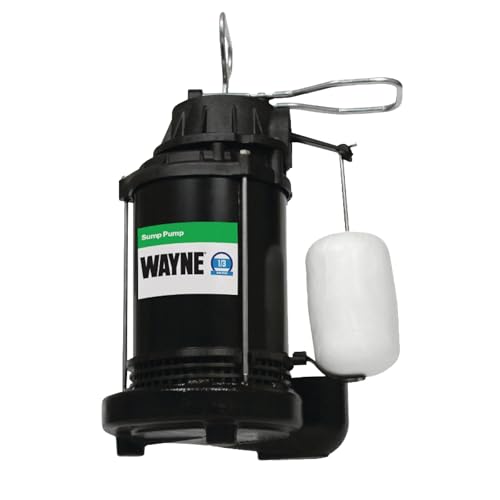
WAYNE CDU790-1/3 HP Submersible Cast Iron and Stainless Steel Sump Pump with Integrated Vertical Float Switch - Up to 4,600 Gallons Per Hour - Heavy Duty Basement Sump Pump, Black
Prices may change · Free shipping with Prime
Flow Curve: What 4,600 GPH Actually Means in Your Pit
The headline number on the box — up to 4,600 gallons per hour — is the zero-lift figure, and it's mostly marketing. The number that matters is the flow at your actual discharge head. Wayne's current published specs list 3,060 GPH at 10 feet of lift, which is the most common real-world condition: roughly 8 feet of basement depth plus elbows and pipe friction. At that head, the CDU790 moves about 51 gallons per minute, enough to keep pace with moderate to heavy inflow in a standard 18-inch basin during sustained storms. (Older spec sheets for earlier CDU790 revisions list a lower 2,700 GPH at 10 feet; the 3,060 figure comes from Wayne's current catalog and matches what's in our catalog data.)
The hydraulic design detail worth knowing is the top-suction intake. Instead of pulling water through a screened bottom, the CDU790 draws from the top of the volute, which Wayne positions as an anti-clog and anti-airlock measure. Air lock — where an air bubble trapped in the volute prevents the pump from priming — is a genuine failure mode on bottom-suction pumps, and the manual still recommends a check valve on the discharge line as a required component, not an option.
For sizing context: if your pit sees heavy inflow and a 1/3 HP pump cycles almost continuously during storms, the honest answer is more horsepower, not a better 1/3 HP. The Wayne CDU800 (1/2 HP) and CDU980E (3/4 HP, 3,500 GPH at 10 feet per published specs) are the step-ups within the same family and share the same general construction philosophy.
The Vertical Float Switch: Strengths and the Known Failure Mode
The CDU790 uses an integrated vertical float switch with a solid polypropylene float, factory-set to turn on at a 9-inch water level and off at 4 inches. Vertical floats have two structural advantages over tether floats: they work in narrow pits (Wayne specifies an 11-inch diameter basin minimum, versus the 14 inches tether designs typically need), and the float travel is constrained by a guide rod, so it can't swing into the pit wall and wedge itself on — one of the most common causes of flooded basements with tether switches.
The failure mode to plan for is the switch contacts themselves. Every mechanical float switch arcs a little each cycle, and over tens of thousands of cycles the contacts wear or weld. Owner reports across retail and forum sources consistently identify the switch — not the motor — as the part that ends a sump pump's life, and Wayne's own manual leans on this reality: it instructs installers to observe several full cycles after installation, requires rigid discharge piping specifically because pump movement can interfere with switch operation, and warns that the float is not adjustable and any modification voids the warranty.
The mitigations are real. The CDU790's float kit, float top kit, and float are published replacement parts, which is more serviceability than most pumps at this price offer. And the manual explicitly recommends an independent high-water alarm or backup pump wherever high water would cause property damage — advice we'd echo for any single-pump installation regardless of brand.
Construction: Cast Iron Where It Counts, Plastic Where It Doesn't Matter
The 'Cast Iron and Stainless Steel' in the product name is accurate but worth unpacking. Per published distributor spec sheets, the base and the motor/switch case are cast iron, the pump housing is stainless steel, the handle, guard, switch arm, and fasteners are stainless, and the impeller is glass-reinforced thermoplastic. The cast iron base does two jobs: it dissipates motor heat and, at about 16.4 pounds, it keeps the pump planted on the pit floor so vibration doesn't walk it into the wall — which loops back to protecting that float switch.
The thermoplastic impeller is the compromise versus the all-cast-iron Zoeller M53. In clear ground water — the only application the manual permits — a glass-reinforced impeller holds up fine and doesn't corrode. Where it gives ground is grit: if your pit regularly ingests sand or silt, cast iron and bronze impellers tolerate abrasion longer. The Zoeller M53 runs a cast iron impeller and volute for roughly $80–$100 more in typical street pricing; the M63 is the heavier 1/2 HP sibling. Whether that upgrade is worth it depends entirely on your water chemistry and sediment load, not on the CDU790 being poorly built.
One genuine materials caveat: this is a clear-water pump, full stop. The manual excludes laundry discharge, water softener backwash, grey water, and anything caustic, and says those uses void the warranty. If your sump pit doubles as a drain for a softener or utility sink, this is the wrong pump.
Installation Realities: Pit Size, Discharge, Cord, and the Fine Print
The physical envelope is compact: roughly 9-3/4 inches wide and 11-1/2 inches tall, with a 1-1/2 inch NPT discharge. The 11-inch minimum basin diameter is genuinely useful for retrofits into older, narrower pits where a tether-float pump physically can't operate. The 8-foot power cord is on the short side — the manual prohibits extension cords outright, so if your receptacle is more than 8 feet from the pit, the correct fix is having an electrician add a GFCI-protected outlet, which the manual requires anyway.
Two installation requirements from the manual deserve emphasis because skipping them causes the most common problems. First, the check valve is mandatory — without it, the column of water in the discharge line falls back into the pit after every cycle, the pump re-pumps the same water, and the short-cycling chews through switch life. Second, the discharge piping must be rigid, not flexible hose, because a pump that shifts or tips during operation can bind the float against the pit wall.
The electrical draw is modest — published distributor data puts it around 9.5 amps at 120V — so a standard 15-amp dedicated circuit is sufficient, but note the manual's unusual caveat that these pumps are not designed to run on portable generator power. If generator backup is part of your flood plan, a battery backup like the Wayne ESP25n or Basement Watchdog BWSP, or a water-powered unit like the Basepump RB750-EZ (which requires adequate municipal water pressure and trades water usage for runtime), is the more compatible path.
CDU790 vs CDU800, CDU980E, and Zoeller M53
Within the Wayne line, the differences are straightforward arithmetic. The CDU790 (1/3 HP, 3,060 GPH at 10 ft, 3-year warranty) is the base model. The CDU800 (1/2 HP) buys you meaningfully more flow at 10 feet for a modest price bump and shares the same warranty. The CDU980E (3/4 HP, 3,500 GPH at 10 ft, stainless motor housing, 5-year warranty per published specs) is the premium option and the one most often recommended for high-inflow pits. If your current pump keeps up in normal storms but falls behind once or twice a year, moving from the CDU790 to the CDU800 is the cheapest real capacity gain.
Against the Zoeller M53 — the other default 1/3 HP recommendation — the comparison is construction versus capacity. The M53 is all cast iron including the impeller and volute, carries a well-regarded reputation among plumbers, and typically costs more; its published flow at 10 feet (around 2,040–2,700 GPH depending on the spec sheet revision) is actually lower than the CDU790's current 3,060 GPH figure. On paper the Wayne moves more water per dollar; the Zoeller's case rests on materials longevity and decades of field history.
The honest framing: for a typical residential pit with clear water and moderate inflow, the CDU790's published capacity and serviceable switch make it the value pick. For sandy or gritty water, or for buyers who weight long service history over spec-sheet flow, the M53 earns its premium. Neither decision is wrong — they're different bets on what kills the pump first.
Who Should Buy It — and Who Shouldn't
The CDU790 fits the largest single slice of the market: a homeowner with a standard 11-inch-or-larger pit, clear ground water, moderate inflow, a 10-foot-ish discharge run, and a budget that rules out premium all-cast-iron pumps. At $137.08 with a 3-year limited warranty and replaceable switch components, it's a defensible primary pump that doesn't ask you to overspend on capacity you don't need.
It doesn't fit a few situations. Heavy, sustained inflow that keeps a 1/3 HP pump running near-continuously calls for the CDU800 or CDU980E. Pits that take laundry, softener, or grey water are explicitly out of the manual's allowed applications — look at effluent-rated pumps instead. Buyers planning to run the primary pump off a portable generator should note the manual's warning against it. And anyone whose basement would be seriously damaged by one missed cycle should treat any single pump as insufficient and budget for a backup — the Wayne ESP25n or Basement Watchdog BWSP on the battery side, or the Basepump RB750-EZ for homes on municipal water with adequate pressure.
None of those limitations are hidden flaws; they're the stated design envelope. Within that envelope, the published specs — 3,060 GPH at 10 feet, cast iron base, stainless housing, serviceable float — make the CDU790 one of the strongest spec-per-dollar primary pumps in the catalog.
Our Verdict
WAYNE CDU790-1/3 HP Submersible Cast Iron and Stainless Steel Sump Pump with Integrated Vertical Float Switch - Up to 4,600 Gallons Per Hour - Heavy Duty Basement Sump Pump, Black
$137.08
Prices may change · Free shipping with Prime
| Full Specifications | |
|---|---|
| Pump Type | submersible |
| Horsepower | 1/3 HP |
| Flow at 10-ft Head | 3060GPH |
| Switch Type | vertical float |
| Housing | mixed |
| Cord Length | 8ft |
| Discharge Size | 1-1/2 |
| Warranty | 3yr |
Frequently Asked Questions
What size sump pit does the Wayne CDU790 need?
Do I need a check valve with the CDU790?
What backup pump should I pair with the CDU790?
How long will the CDU790 last, and what maintenance does it need?
Is the CDU790 enough pump, or should I buy the CDU800 instead?
Related Buying Guides
Compare With Similar Sump Pumps
Head-to-Head Comparisons
WAYNE CDU790-1/3 HP Submersible Cast Iron and Stainless Steel Sump Pump with Integrated Vertical Float Switch - Up to 4,600 Gallons Per Hour - Heavy Duty Basement Sump Pump, Black
$137.08
Prices may change · Free shipping with Prime