
Wayne
CDU800
$158.78
Pros & Cons
Pros
Cons
At a Glance
Overview
The Wayne CDU800 is the pump that comes up when a homeowner asks for 'a real 1/2 HP sump pump that isn't a $300 plumber's-brand unit.' It's a 1/2 HP submersible with a cast iron base, an epoxy-coated steel motor housing, a vertical float switch, and a published 3,840 GPH at 10 feet of head — and at $158.78 it undercuts the Zoeller M53 and Liberty 287 on price while moving nearly twice the water of the M53 on paper. For a typical suburban basement with a standard 11-inch-or-larger pit and a normal 8-to-10-foot discharge run, it sits squarely in the sweet spot of the catalog.
What defines the CDU800 isn't any single spec — it's the combination of capacity, switch design, and construction at this price. Wayne publishes a max flow of 5,100 GPH at zero lift and states the pump is tested to one million switch cycles, and the top-suction intake design means there are no weep holes to drill and fewer places for an air lock to form. Owner reports across retail sites consistently describe it as a quiet, set-it-and-forget-it primary pump, which matches what the spec sheet suggests.
The honest caveat is the warranty and the switch. Three years of coverage is standard for Wayne but shorter than what Zoeller's higher-end M63 (5 years) or a Liberty 287 setup implies in service reputation, and the integrated vertical float — like every float switch — is the component most likely to wear out before the motor does. Buyers in flood-prone areas with heavy cycling should plan around the switch as a maintenance item and pair the CDU800 with a backup, which is exactly the role Wayne designed it for in combos like the WSS30V.
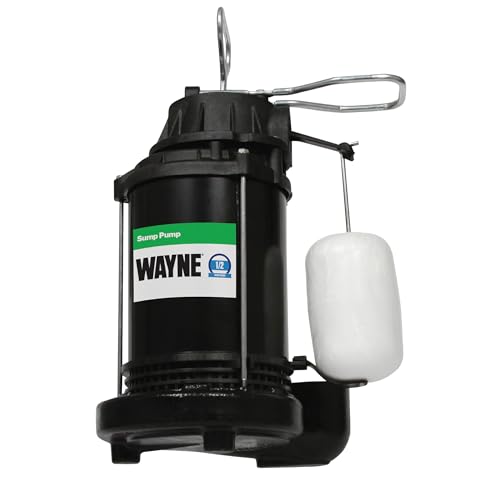
WAYNE CDU800 1/2 HP Submersible Sump Pump – Cast Iron & Stainless Steel, Vertical Float Switch, 5,100 GPH, 3-Year Warranty
Prices may change · Free shipping with Prime
Flow Numbers: 5,100 GPH at Zero Lift, 3,840 GPH at 10 Feet
Wayne's published performance for the CDU800 is 5,100 GPH at 0 feet of discharge lift and 3,840 GPH at 10 feet. That 10-foot figure is the one that matters, because a real basement install — up out of the pit, through a check valve, and out through the rim joist — typically works out to roughly 8 to 12 feet of total head. At that realistic point on the curve, the CDU800 still moves about 64 gallons per minute, which is strong for a 1/2 HP residential unit.
For context within the catalog: the 1/3 HP Wayne CDU790 and Zoeller M53 both live around 2,000–2,100 GPH at 10 feet per published specs, the 3/4 HP Wayne CDU980E pushes about 4,743 GPH at 10 feet, and the M53's 2,040 GPH at 10 feet is barely more than half of what the CDU800 publishes. If your pit fills fast during spring storms — a high water table, a long drainage-tile loop, or a walkout that funnels runoff — the CDU800's extra capacity at working head is the main reason to choose it over a 1/3 HP unit.
Wayne does not prominently publish a 5-foot figure for this model, so treat anything between the 0- and 10-foot points as an interpolation rather than a spec. Retailer spec listings put maximum shut-off head around 20 feet; if your discharge run exceeds roughly 15 feet of vertical lift, step up to the CDU980E or a 1 HP unit like the Aquastrong 1HP rather than asking the CDU800 to work at the top of its curve.
Top Suction, No Weep Hole: The Design Detail That Prevents Air Lock
Most submersible sump pumps draw water through a screen at the very bottom of the unit, and most manufacturers require a small weep hole drilled in the discharge pipe below the waterline to bleed air and prevent air lock. The CDU800 uses a top-suction intake instead: water enters above the impeller housing, which keeps the impeller submerged as long as there's water at the pump, and Wayne's design eliminates the weep-hole requirement entirely.
Why that matters in practice: weep holes clog. In pits with sandy or silty inflow, the 3/16-inch hole in the discharge pipe gradually fills with fines, the pump starts gulping air, and eventually it runs dry against an air pocket while the pit keeps rising. Owner complaints about sump pumps 'running but not pumping' trace back to air lock more often than to failed motors. The top-suction layout sidesteps the whole failure mode, and it also reduces the amount of debris the intake ingests from the pit floor.
The tradeoff of any suction design in a dirty pit still applies: if your pit regularly sees gravel, mulch, or construction debris, no primary pump is the right tool — that's what a sewage/effluent pump is for. For normal groundwater and drainage-tile inflow, the CDU800's intake geometry is one of its strongest engineering arguments over bottom-suction competitors at the same price.
The Vertical Float Switch: Million-Cycle Rating, but Plan for It Anyway
The CDU800's switch is an integrated vertical float with a solid, leak-free polypropylene float, fixed ON at 9 inches and OFF at 4 inches, protected by a float guard. Wayne states the pump is tested to one million cycles. The vertical format is the right choice for pits under about 18 inches in diameter because it travels straight up and down a guide rod instead of swinging an arc like a tethered float — a tethered switch in a narrow pit eventually wedges against the wall or the discharge pipe and either never turns on or never turns off.
The 5-inch differential between ON and OFF is worth understanding. It gives short, frequent cycles: the pump clears a shallow slug of water, shuts off, and the pit refills. In a wet season with steady inflow, that can mean dozens of cycles per hour, and every cycle is a start-current event on the motor and a mechanical actuation of the switch. This is inherent to all integrated vertical floats — the Zoeller M53 behaves the same way — and it's the reason the switch, not the motor, is the expected first failure point on any of these pumps.
Owner reports across retail and forum coverage of the CDU800 follow the usual pattern: units that die early almost always die at the switch, typically after years of heavy cycling. The mitigation is cheap and worth doing — keep the pit clean so the float travels freely, verify the float can't snag on the cord or discharge pipe, and install a high-water alarm so a stuck switch announces itself as an alarm instead of a flooded basement. If the switch fails out of warranty, the replacement-pump cost is $158.78, not a service call plus parts on a proprietary assembly.
Construction and Fit: Cast Iron Base, 11-Inch Pit, 1-1/2-Inch Discharge
The build is a mix of materials, each doing the right job: a cast iron base for mass and corrosion resistance where the pump sits in the pit, an epoxy-coated steel motor housing, and stainless hardware. At about 18.5 pounds and roughly 10 x 10 x 14 inches, it has the heft that keeps a pump planted during start-up torque instead of walking across the pit floor — a real annoyance with lightweight thermoplastic units like the Superior 91250.
Fit requirements are friendly to existing installations. Wayne specs the CDU800 for an 11-inch-diameter or larger sump basin, the discharge is 1-1/2 inch NPT (adaptable to 1-1/4 inch plumbing found in many older homes), and the power cord is 8 feet — enough to reach a lid-mounted grommet in most pits without an extension cord, which you should never use on a sump pump anyway. The pump runs on a standard 120V household circuit; check the nameplate on your unit for exact amperage before deciding whether it shares a circuit.
One practical note on the discharge: pair it with a full-flow check valve mounted a few inches above the pump, and size the discharge line to match. Running a 3,840-GPH pump through a long run of 1-1/4 inch pipe with elbows adds friction head and eats into the published flow numbers. If you're replumbing anyway, 1-1/2 inch all the way out preserves the capacity you're paying for.
Wayne CDU800 vs Zoeller M53 vs Liberty 287: The Value Argument
The three pumps a buyer at this level actually cross-shops are the CDU800 ($158.78), the Zoeller M53, and the Liberty 287 — all submersible, all vertical float, all cast-iron-family construction. The differences are capacity, warranty, and price, not fundamental quality.
The Zoeller M53 is the plumber's default: all cast iron, a reputation for 10-plus-year service lives, and a street price typically well above the CDU800. Its published 2,040 GPH at 10 feet is barely half the CDU800's 3,840 GPH at the same head, though — the M53 is a 1/3 HP pump priced like a 1/2 HP because of the brand's service record. The Liberty 287 is the true spec-for-spec competitor: 1/2 HP, cast iron, vertical magnetic float, and a price usually meaningfully higher than the Wayne, with Liberty's strong warranty reputation behind it.
The honest summary: if you want the longest expected service life and a dealer/service network, the Zoeller M63 (1/2 HP, 5-year warranty) or Liberty 287 are the premium buys. If you want the most gallons moved per dollar with a mainstream brand and a real 3-year warranty, the CDU800 wins on the numbers. And if capacity is the whole story, the 3/4 HP Wayne CDU980E at about 4,743 GPH at 10 feet is the step up within the same family.
Backup Pairing and the Limits of Any Single Corded Pump
Every primary sump pump has the same two blind spots: the power goes out, and the switch eventually fails. Storms cause both basement inflow and power outages at the same time, so a primary-only setup is a half solution regardless of which primary you buy. Wayne clearly designed the CDU800 with this in mind — it's the primary pump inside the factory WSS30V combination system.
For a DIY pairing, the natural battery backup is the Wayne ESP25n (or the Basement Watchdog BWSP if you prefer that ecosystem). A 12V backup like the ESP25n handles a few thousand gallons per charge cycle depending on head and battery size — enough to bridge an overnight outage, not a week-long one. If you're on municipal water and want outage-proof runtime with no battery to maintain, a water-powered backup like the Basepump RB750-EZ or Liberty SJ10 trades water usage for unlimited runtime, provided your home has the required municipal pressure and you accept the water bill during operation.
Sizing note: the backup doesn't need to match the CDU800's 3,840 GPH. It needs to keep up with inflow during an outage, and inflow during a power-failing storm is the same inflow your primary handles — but a backup cycling slowly beats no backup at all. Whichever you choose, give the backup its own check valve and its own float set higher than the CDU800's 9-inch ON point, so it only runs when the primary has already lost the fight.
Our Verdict
WAYNE CDU800 1/2 HP Submersible Sump Pump – Cast Iron & Stainless Steel, Vertical Float Switch, 5,100 GPH, 3-Year Warranty
$158.78
Prices may change · Free shipping with Prime
| Full Specifications | |
|---|---|
| Pump Type | submersible |
| Horsepower | 1/2 HP |
| Flow at 10-ft Head | 3840GPH |
| Switch Type | vertical float |
| Housing | mixed |
| Cord Length | 8ft |
| Discharge Size | 1-1/2 |
| Warranty | 3yr |
Frequently Asked Questions
What size sump pit does the Wayne CDU800 need?
Do I need a check valve with the CDU800?
Is the CDU800 enough pump for a wet basement, or should I get 3/4 HP?
What backup pump pairs well with the CDU800?
What maintenance does the CDU800 need, and what does the warranty cover?
Related Buying Guides
Compare With Similar Sump Pumps
Head-to-Head Comparisons
WAYNE CDU800 1/2 HP Submersible Sump Pump – Cast Iron & Stainless Steel, Vertical Float Switch, 5,100 GPH, 3-Year Warranty
$158.78
Prices may change · Free shipping with Prime