
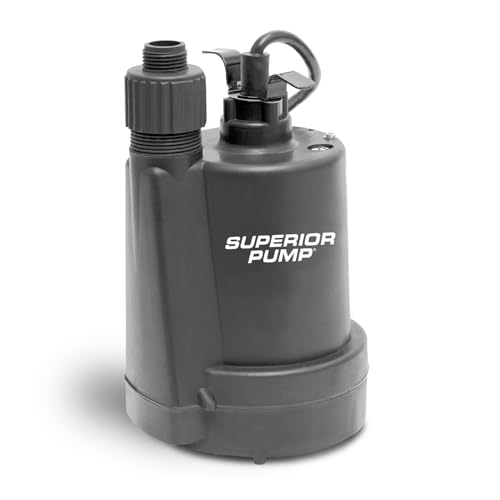
Superior Pump
91250
$62.49
Pros & Cons
Pros
Cons
At a Glance
Overview
The Superior Pump 91250 is the pump that shows up when someone asks 'what's the cheapest way to move water out of my basement?' It is, at $62.49, the least expensive unit in our catalog — roughly a third of a Wayne CDU980E and a fifth of a Zoeller M63 — and it has held that budget crown for years because the specs behind the price are honest ones. This is a 1/4 HP thermoplastic utility pump, and Superior publishes the full flow curve rather than hiding behind the headline number: 1,800 GPH at 0 feet of head, 1,320 at 5 feet, 1,200 at 10 feet, falling to 540 at 20 feet and 120 at its 25-foot maximum lift.
One thing needs to be said up front, because the listing title invites the confusion: the 91250 is a utility pump, not a sump pump in the strict sense. It has no float switch. It runs when you plug it in and stops when you unplug it (or when it runs dry, which the manual warns against). Superior's own spec sheet notes it 'can be used as a sump pump by adding an optional float switch' — that addition is on you. Buyers who understand that distinction get a genuinely useful tool for the money. Buyers who don't are the source of most of the negative owner reports you'll find.
So the right frame for this review is not 'cheap sump pump' but 'portable dewatering tool that can be pressed into light sump duty.' Within that frame, the 91250 makes a strong case for itself: top-discharge 1-1/4" NPT with a 3/4" garden hose adapter in the box, a 10-foot cord, 1/8" solids handling, and the ability to pump down to about 1/8 inch of standing water — deeper suction than most float-equipped sump pumps will ever reach.
Superior Pump 91250 1800GPH Thermoplastic Submersible Utility Pump with 10-Foot Cord, 1/4 HP
Prices may change · Free shipping with Prime
The Flow Curve Is the Whole Story — Read It Before You Buy
Manufacturer marketing leads with 1,800 GPH, which is the 0-foot-head number — the pump sitting in a puddle, discharging at ground level. Almost no real installation looks like that. A typical basement sump or dewatering job lifts water 8 to 12 feet to get it out through a rim joist or up and over a foundation wall, and on the published curve that means 1,200 GPH at 10 feet of head. That's the number to plan around.
At 1,200 GPH at 10 feet, the 91250 moves 20 gallons per minute — adequate for a leaking water heater, a washing machine overflow, a window well that filled during a storm, or a sump pit in a home with light-to-moderate inflow. Where it runs out of headroom is sustained heavy inflow: if your pit takes on water faster than roughly 20 GPM during storms, a 1/4 HP utility pump will cycle nonstop and still lose ground. That's when the honest answer is a bigger primary pump — the Wayne CDU980E (3/4 HP, around 4,600 GPH at 10 feet) or the Zoeller M53, both of which are built for exactly that duty.
The top of the curve matters too. Maximum lift is 25 feet, where flow drops to a 120 GPH trickle. If your discharge run climbs more than one story — say, pumping from a deep basement up to grade and then across a long horizontal run with its own friction losses — the 91250 is the wrong tool. Friction loss in a long garden hose makes this worse; the included 3/4" adapter is convenient, but a 50-foot garden hose at these flow rates costs you meaningful head. Short, large-diameter discharge runs are where this pump performs as advertised.
No Float Switch — Design Choice, Not Defect (Until You Forget It)
The 91250 is a manual pump. There is no tethered float, no vertical float, no electronic level sensor — the spec sheet lists no switch at all. Plug it in, it runs. For a utility pump this is a feature: float switches are the single most common failure point on residential sump pumps, and eliminating the switch eliminates the failure mode. It also lets the pump draw water down to roughly 1/8 inch of depth, far below the cut-out level of any float-equipped pump, which is why pool-cover, water-heater-pan, and post-flood cleanup jobs favor this design.
For sump duty the calculus flips. An unattended pit needs automatic cycling, which means buying Superior's optional tethered float switch (or a universal piggyback float) and accepting the failure modes that come with it: a tethered float can tangle on the cord or hang up on the pit wall, and in a narrow pit a tethered switch is a poor fit. If you're planning float-equipped permanent installation from day one, price the pump plus the float plus your time against a purpose-built unit like the Wayne CDU790 or Zoeller M53, which ship with integrated vertical switches engineered for the pit.
One related caution from the manual and owner reports: do not let the pump run dry for extended periods. The motor is continuous-duty and thermally protected — it will shut itself off rather than burn out if it overheats — but repeated thermal-cycling from dry running is how budget pumps die early. A float switch set to cut out above the intake screen prevents this; so does simply staying nearby during manual dewatering jobs, which is what the pump is designed for.
Thermoplastic Construction — What It Costs You and What It Doesn't
The housing, volute, and impeller are thermoplastic, which is the honest way a pump hits $62.49. Plastic doesn't corrode, it's light enough to carry one-handed, and for intermittent clean-water duty it holds up fine — Superior advertises solid copper motor windings and 100% factory testing, and the motor is a continuous-duty, thermally protected split-capacitor design, which is a better motor spec than the price suggests.
The real trade-offs versus cast iron (the Zoeller M53/M63 construction, or the Wayne CDU800/CDU980E) are heat dissipation and long-term abrasion resistance. Iron housings sink motor heat into the surrounding water more effectively during sustained heavy cycling, and iron impellers tolerate grit better. Thermoplastic survives years of occasional use; it wears faster under daily cycling against sandy inflow. The 1/8-inch solids rating means the removable suction screen keeps out anything larger than a small pebble — fine for typical basement water, not fine for construction-site slurry.
The warranty tells you how Superior itself prices this trade-off: 1 year, versus 3 years on the Wayne CDU series and 5 years on a Zoeller M63. That's not an indictment — it's a signal about intended duty. Owner reports generally describe 91250s lasting many years in occasional-use roles (pool covers, water changes, storm cleanup) and shorter lives when pressed into service as the sole primary pump in a wet pit. Match the tool to the duty cycle and the thermoplastic build is a sensible economy, not a compromise.
Where the 91250 Actually Fits — Dewatering, Backup, and Light Sump Duty
Based on the published specs, the 91250's best roles are the portable ones. Flooded basement cleanup after a supply-line failure: 1,800 GPH at low head empties a room fast and sucks down to a wet film a shop vac can finish. Draining a water heater, hot tub, or pool cover: the garden hose adapter and 10-foot cord make it a grab-and-go tool. Emptying a window well or a low spot in the yard: top discharge and a 6.8-pound carry weight are exactly right. This is a pump that earns its shelf space even in homes that already own a serious sump system.
As a primary sump pump it fits a narrower profile: a home with a genuinely dry-to-light water table, a pit that sees action a few times a year, and an owner willing to add a float switch and check the unit periodically. The math on inflow matters — if you don't know your pit's peak inflow rate, assume you need more than 1/4 HP. A 1/3 HP cast-iron unit like the Zoeller M53 or Wayne CDU800 is the conventional floor for 'primary pump I never think about.'
Where the 91250 makes a quiet kind of sense is as the secondary in a two-pump strategy: a proper primary in the pit, plus a 91250 on the shelf for the day the primary fails mid-storm. At $62.49 it's cheap insurance, though for true unattended backup — power outage, nobody home — a self-activating system like the Wayne ESP25n or Basement Watchdog BWSP battery backup, or the water-powered Basepump RB750-EZ, is the correct category. The 91250 needs you to be home, awake, and holding the plug.
Superior 91250 vs Aquastrong 1HP vs Wayne ESP25n — Same Shelf, Different Jobs
Three products in our catalog compete for the buyer standing in the utility-pump aisle, and they are not really interchangeable. The Superior 91250 ($62.49) is the light, cheap, portable clean-water mover: 1/4 HP, 1,200 GPH at 10 feet, 1-year warranty. The Aquastrong 1HP utility pump trades portability for throughput — around 4,500-plus GPH at low head by its published specs — which makes it the better pick for draining a pool, a flooded crawlspace, or any big-volume job where time is the constraint. It costs more, weighs more, and for occasional basement puddles it's overkill in exactly the way the 91250 isn't.
The Wayne ESP25n is a different category wearing similar clothes. It's a 12-volt battery backup sump pump with its own float switch and charger — it doesn't compete with the 91250 so much as complement it. If your actual fear is 'the power goes out during the storm,' neither the 91250 nor the Aquastrong addresses that at all; both are 115V AC pumps that are dead in an outage. The ESP25n or the Basement Watchdog BWSP is the answer to that problem, and the 91250 remains the answer to 'there's water where it shouldn't be and I need it gone this afternoon.'
Against its own brand family, the 91250's closest sibling is Superior's 91255, the same pump with a tethered float switch included. If you know you want float operation, the sibling is usually the cleaner buy than the 91250 plus a separately sourced float. Either way, you're in thermoplastic, 1-year-warranty territory — fine as light duty, not a substitute for a Zoeller M53 or Liberty 287 in a wet pit.
Our Verdict
Superior Pump 91250 1800GPH Thermoplastic Submersible Utility Pump with 10-Foot Cord, 1/4 HP
$62.49
Prices may change · Free shipping with Prime
| Full Specifications | |
|---|---|
| Pump Type | submersible |
| Horsepower | 1/4 HP |
| Flow at 10-ft Head | 1200GPH |
| Switch Type | n/a |
| Housing | thermoplastic |
| Cord Length | 10ft |
| Discharge Size | 1-1/4 |
| Warranty | 1yr |
Frequently Asked Questions
Can the Superior 91250 be used as a sump pump?
Do I need a check valve with the 91250?
How much water will it actually move in a real basement installation?
What maintenance does the 91250 need?
Should I pair the 91250 with a battery backup system?
Related Buying Guides
Compare With Similar Sump Pumps
Head-to-Head Comparisons
Superior Pump 91250 1800GPH Thermoplastic Submersible Utility Pump with 10-Foot Cord, 1/4 HP
$62.49
Prices may change · Free shipping with Prime