
Aquastrong
ESU100PM
$59.39
Pros & Cons
Pros
Cons
At a Glance
Overview
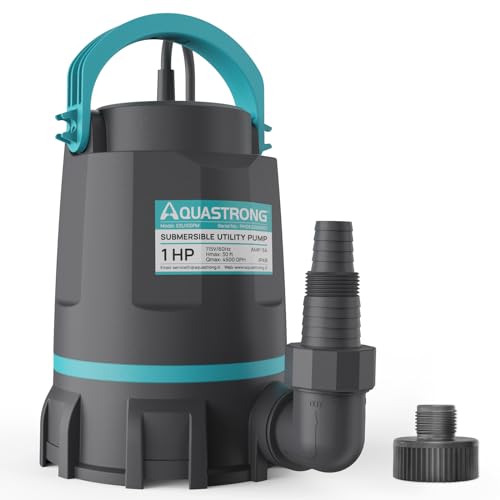
The Aquastrong 1 HP (model ESU100PM) is the pump that shows up when you search Amazon for a cheap way to move a lot of water fast. At $59.39 it costs roughly a third of a Wayne CDU980E and less than half of a Zoeller M53, yet its published rating — 4500 GPH with a 30-foot maximum lift — matches or beats both on paper. That combination is exactly why it sells, and exactly why it deserves a careful read of the fine print before you drop it in a sump pit.
The fine print matters because this is, at its core, a portable utility pump wearing sump-pump clothes. Aquastrong's own listing markets it for swimming pools, garden ponds, hot tubs, flooded basements, and window wells — occasional, attended water removal. The variant reviewed here has no float switch: you plug it in to run it and unplug it to stop it. That makes it a genuinely useful tool for emergency dewatering, pool cover duty, and as a second pump staged above your primary, but a risky choice as an unattended primary sump pump unless you add a switch yourself.
What follows is a spec-research-based review grounded in Aquastrong's published specifications and manual, plus patterns that show up consistently in owner reports across retail listings. We'll cover what the 4500 GPH number really means at real-world head heights, what the thermoplastic build buys you and what it costs you, where this pump legitimately fits in a basement water-management plan, and where you should spend more on a Wayne, Zoeller, or Liberty instead.
Aquastrong Sump Pump 1 HP 4500 GPH Submersible Water Pump Thermoplastic Portable Utility Pump High Flow Water Removal for Swimming Pool Garden Pond Basement Window Wells with 10ft Long Power Cord
Prices may change · Free shipping with Prime
What 4500 GPH Actually Means in a Real Basement
The headline number needs context. Aquastrong publishes the 4500 GPH figure (75 gallons per minute) at 5 feet of head, with a maximum shutoff lift of 30 feet. A typical basement installation lifts water 8 to 10 feet vertically before the discharge line turns horizontal, and every elbow and every foot of horizontal run adds friction loss on top of that. Aquastrong does not publish a full flow curve showing GPH at 10 feet, so the honest statement is: expect something below 4500 GPH at a real sump install, and expect flow to fall steadily as head rises toward the 30-foot ceiling.
Even so, the class of pump matters more than the exact curve. A 1 HP motor moving water through a 1-1/4 inch discharge will outmove any 1/3 or 1/2 HP primary pump during an inflow event, which is why owner reports consistently describe it emptying pools, hot tubs, and flooded floors at impressive speed. For comparison, the Wayne CDU980E — a dedicated 3/4 HP primary sump pump — is rated around 4600 GPH at 5 feet. The Aquastrong is in the same flow conversation for a third of the money.
Two published details broaden its usefulness. The bottom-suction intake is rated to pass solids up to 1/5 inch and to pull water down to roughly 1/5 inch from the floor surface. That last spec is why this pump keeps showing up in pool-cover and window-well duty: it sucks nearly dry rather than leaving an inch of standing water the way a pedestal-style intake does. It also means the intake screen will ingest small gravel and debris, so keeping the screen clean is not optional maintenance — it's the difference between the rated flow and a clogged impeller.
No Float Switch — The Defining Limitation
This is the single most important thing to understand before buying. The ESU100PM variant sold at this listing ships without any automatic switch. Operation is manual: plug in to run, unplug to stop. Aquastrong sells a sibling variant with an adjustable tethered float switch for automatic on/off, and the manual for the float models also describes securing the switch for continuous manual operation — but that is a different SKU. If you need unattended, water-level-triggered pumping, either buy the float-switch version or budget for a separate piggyback float switch on this one.
Why belabor this? Because the number one failure mode in sump duty isn't the motor — it's the switch, and the second is a pump that never switches on at all. A manual-only pump in a sump pit will happily sit silent through a 2 a.m. storm while the pit overtops. Dedicated primaries like the Wayne CDU800, Wayne CDU980E, and Zoeller M53 all ship with integrated vertical or tethered float switches precisely because sump duty is unattended duty.
There's a flip side worth acknowledging. A bottom-suction utility pump with no float has no switch to foul, no float to wedge against the pit wall, and no minimum pit diameter dictated by float travel. For attended tasks — draining a water heater, a flooded crawl space you're standing in, a pool — manual control is arguably simpler and more reliable. And as a staged emergency pump sitting on a shelf or above your primary's high-water line, 'plug it in when you need it' is a legitimate operating plan, especially paired with a water alarm so you know when to plug it in.
Thermoplastic Build — What You Get at $59.39
The housing is reinforced engineering thermoplastic, which is standard for this price tier and nothing to apologize for. Thermoplastic doesn't rust, doesn't care about sitting in a damp pit for months, and keeps the pump light enough to carry one-handed with its 10-foot cord — genuinely useful for a pump whose job description includes 'grab it when something floods.' The trade-off against cast iron is heat dissipation and long-term abrasion resistance. A Zoeller M53 or Wayne CDU980E uses a cast-iron or cast-iron-and-steel body partly because iron sinks motor heat during long, hard run cycles; thermoplastic pumps are happier with intermittent duty.
Two protective features in the published spec sheet do real work here. The motor has a built-in thermal overload protector that cuts power if the pump overheats — most commonly from running dry after the pit empties or from a blocked intake — and resets rather than burning the windings. Given that a manual pump WILL eventually be left running past empty, this protector is what stands between an oops and a dead pump. The shaft uses a mechanical seal, the design point that keeps water out of the motor housing and is the usual end-of-life component on any submersible.
Plumbing is flexible out of the box. The discharge is 1-1/4 inch NPT, and Aquastrong includes a 1-1/2 inch elbow adapter plus snap-coupling adapters for 3/4, 1, and 1-1/4 inch hose. For permanent sump installation you'd hard-plumb 1-1/2 inch PVC with a check valve; for portable duty a lay-flat discharge hose on the snap fitting is the intended use. The 10-foot power cord is UL-listed but on the short side — measure the distance from your pit to the outlet before assuming it reaches, and never run it through an extension cord lying across a wet floor.
Where This Pump Fits — and Where It Doesn't
The honest fit list, based on the published design and the use cases Aquastrong itself advertises: pool and pool-cover draining, hot tub emptying, garden pond transfer, window-well evacuation, flooded basement or crawl space cleanup, and staging as a high-capacity emergency pump behind a real primary. In all of these, the combination of high flow, near-dry bottom suction, light weight, and a $59.39 price is genuinely hard to beat. The Superior 91250 — the other budget thermoplastic utility pump buyers cross-shop — is only a 1/4 HP unit moving roughly 1800 GPH; the Aquastrong more than doubles that flow for similar money, which makes it the stronger utility-pump pick of the two on published specs.
Where it doesn't fit: as your only line of defense in a finished basement with active groundwater. That job wants an automatic primary with a proven switch (Wayne CDU980E for high flow, Zoeller M53 for cast-iron longevity, Liberty 287 for a mid-price automatic), a check valve, and a backup. Aquastrong covers its pumps with a 2-year warranty extendable to 3 years with registration, which is respectable — but Zoeller and Wayne have decades of installed-base track record that a newer value brand simply hasn't accumulated yet. When the consequence of failure is a ruined basement, that track record is what the extra money buys.
If you do run the Aquastrong in a sump-adjacent role, the sensible architecture is layered: a dedicated automatic primary in the pit, a battery backup such as the Basement Watchdog BWSP or Wayne ESP25n (or the water-powered Basepump RB750-EZ if you have municipal water with adequate pressure) for outage protection, and the Aquastrong on the shelf — or plumbed at a high-water elevation — as the high-capacity 'oh no' pump you deploy when inflow exceeds the primary. At this price, that third layer costs less than a single service call.
Aquastrong ESU100PM vs the Usual Suspects
Against the Superior 91250, the Aquastrong wins the utility-pump comparison decisively on published specs: 1 HP versus 1/4 HP, 4500 GPH versus roughly 1800 GPH, both thermoplastic, both manual, both under about $65. The Superior's counterargument is brand tenure and a removable suction screen that's easier to service, but if the job is moving water fast and cheap, the Aquastrong's spec sheet dominates.
Against dedicated primaries, the comparison inverts. The Wayne CDU800 (1/2 HP, vertical float) and CDU980E (3/4 HP, ~4600 GPH at 5 ft) and the Zoeller M53 (1/3 HP cast iron) all cost two to four times as much — and all three switch themselves on at 2 a.m., which is the entire point of a sump pump. The Zoeller M63 steps that up with a heavier cast-iron build and a 5-year warranty for buyers who treat the pump as infrastructure. None of these are better utility pumps than the Aquastrong; all of them are better sump pumps. The categories only overlap in marketing copy.
The bottom line: buy the Aquastrong ESU100PM for what it is — a high-flow, near-dry-suction portable utility pump at a price that makes owning one a rounding error — and it's an easy recommendation. Buy it as a silent, unattended primary in a basement you'd be sad to flood, and you've saved $100 in the wrong place. If you want the Aquastrong brand in the pit, get the tethered-float variant or add a piggyback switch; if you want set-and-forget, the Wayne CDU980E is the flow-matched automatic answer.
Our Verdict
Aquastrong Sump Pump 1 HP 4500 GPH Submersible Water Pump Thermoplastic Portable Utility Pump High Flow Water Removal for Swimming Pool Garden Pond Basement Window Wells with 10ft Long Power Cord
$59.39
Prices may change · Free shipping with Prime
| Full Specifications | |
|---|---|
| Pump Type | submersible |
| Horsepower | 1 HP |
| Flow at 10-ft Head | — |
| Switch Type | n/a |
| Housing | thermoplastic |
| Cord Length | 10ft |
| Discharge Size | 1-1/4 |
| Warranty | — |
Frequently Asked Questions
Can the Aquastrong 1 HP be used as a primary sump pump?
What size discharge pipe and check valve does it need?
Will it fit in a small sump pit?
What backup should I pair with it?
What maintenance and warranty coverage should I expect?
Compare With Similar Sump Pumps
Head-to-Head Comparisons
Aquastrong Sump Pump 1 HP 4500 GPH Submersible Water Pump Thermoplastic Portable Utility Pump High Flow Water Removal for Swimming Pool Garden Pond Basement Window Wells with 10ft Long Power Cord
$59.39
Prices may change · Free shipping with Prime