
Basepump
RB750-EZ
$366
Pros & Cons
Pros
Cons
At a Glance
Overview
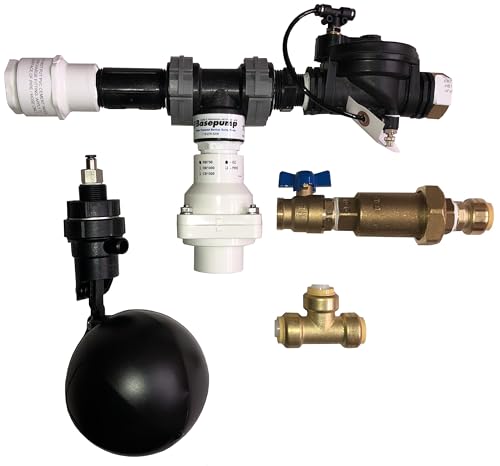
The Basepump RB750-EZ takes a fundamentally different approach to backup sump pumping: no battery, no charger, no 12-volt electrical anything. It runs on your municipal water pressure. When the float rises, a hydraulic valve opens and city water flowing through a venturi ejector pulls sump water up and out — roughly 2 gallons of sump water removed for every 1 gallon of municipal water consumed, per Base Products Corporation's published figures. At $366 it's priced at the premium end of the water-powered category, but it's a complete DIY-oriented kit, and the 5-year warranty is the longest in this class (the Liberty SJ10, by comparison, carries 3 years).
The value proposition only works if your house can supply it. Basepump's own requirements are strict: 40 to 90 PSI of municipal water pressure at the ejector, full-flow copper/PEX/CPVC piping (no galvanized iron), a 5/8" or 3/4" water meter, and the ability to fill a 5-gallon bucket from a hose spigot in under 40 seconds. Homes on wells are disqualified entirely — a well pump dies in the same power outage that takes out your primary sump pump. For homes that meet the checklist, the payoff is a backup that runs indefinitely during an outage, with no battery to age out every 3-5 years.
Rated capacity at 10 feet of lift is 700 GPH at 40 PSI supply pressure, scaling to 750 GPH at 60 PSI, 800 GPH at 80 PSI, and 900 GPH at 90 PSI. That's genuinely modest next to a battery unit like the Wayne ESP25n or Basement Watchdog BWSP on a fresh battery, and far below a primary pump like the Zoeller M53. The RB750-EZ is not trying to win a flow-rate contest — it's selling the guarantee that it will still be pumping on hour 30 of a blackout, when every battery system in the neighborhood has gone quiet. Whether that tradeoff fits your pit depends on your inflow rate, which the sections below break down.
Basepump RB750-EZ Premium Water Powered Backup Sump Pump System
Prices may change · Free shipping with Prime
How the Venturi Ejector Works — and Why There's Almost Nothing to Break
The RB750-EZ's ejector is a polypropylene venturi body that mounts above the sump pit on the discharge piping. Municipal water enters under pressure, accelerates through a nozzle inside the ejector, and the resulting low-pressure zone draws sump water up the suction pipe and pushes the combined stream out the discharge. There is no motor, no impeller, no bearings, and no electrical connection to the pump itself. The only moving parts are the valve actuated by the float and the float itself.
The float system is hydraulic rather than electrical: a float unit sits in the pit and connects to the ejector valve via a small hydraulic transfer tube. Rising water lifts the float, which opens the municipal water valve; falling water closes it. Because there's no electrical switch, the classic sump pump failure modes — a stuck tethered float switch, a failed vertical switch reed, a corroded piggyback plug — don't exist here. That matters, because switch failure is the most common reason primary pumps die.
The failure modes that do remain are mechanical and municipal: debris clogging the suction screen (a screen is included), the float hanging up on pit walls or cords, a failed check valve allowing backflow, or a loss of city water pressure itself. Base Products assembles the units in Buffalo, NY, and owner reports generally describe multi-year service lives with nothing more than occasional screen cleaning. For a backup device that may sit idle for a year and then need to work perfectly, few moving parts is the entire point.
Flow Rate Reality Check: 700-900 GPH Against Real Inflow
Published pumping rates for the RB750 at 10 feet of head are 700 GPH at 40 PSI, 750 GPH at 60 PSI, 800 GPH at 80 PSI, and 900 GPH at 90 PSI supply pressure. Base Products' own comparison table lists 725 GPH at a 50 PSI average. Notice the direct dependency: your backup capacity is only as good as your water pressure on the worst day. If your neighborhood pressure sags during a major storm — it happens when hydrants are flushed or demand spikes — your backup flow sags with it.
Is 750 GPH enough? That depends entirely on your pit's inflow rate during a real storm, and it's the single most important sizing question for this pump. A moderate inflow of 5 gallons per minute is 300 GPH — the RB750 handles that with margin. A heavy inflow of 15 GPM is 900 GPH, which only a house at 90 PSI supply could match, with zero reserve. If your primary pump (say a Wayne CDU980E at 5,490 GPH or a Zoeller M53 at 2,680 GPH) is cycling hard every minute or two during storms, a water-powered backup alone may lose the battle if the power goes out at the wrong moment.
The honest way to size it: during the next heavy rain, time your primary pump's cycle and estimate inflow, or simply observe how fast the pit refills with the pump unplugged for 30 seconds (with supervision). If inflow is under roughly 10 GPM and your pressure is 60 PSI or better, the RB750-EZ is adequate. If inflow is heavier, look at Basepump's higher-capacity models (the HB1000 at 950 GPH or CB1500 at 1,450 GPH, which require 3/4" plumbing) or a battery backup with higher peak flow.
The Water-Usage Tradeoff — What 'Unlimited Runtime' Actually Costs
The RB750-EZ's headline advantage over battery backups — unlimited runtime during an outage — has a meter attached to it. Per the manufacturer's published ratio, the pump uses about 1 gallon of municipal water to remove 2 gallons of sump water (Base Products advertises 1 gallon removing 1.5 to 2 gallons depending on pressure). At 750 GPH of sump output, you're consuming roughly 375 to 500 gallons of city water per hour of continuous operation.
Run that math through a real scenario: a 12-hour outage during a storm where the backup runs 50% of the time means 6 hours of pumping — somewhere around 2,250 to 3,000 gallons of municipal water, or about 3 to 4 CCF on your water bill. Depending on local rates, that's roughly $10 to $30 per significant event. That's not nothing, but compare it against the alternative costs: a Basement Watchdog BWSP or Wayne ESP25n needs its AGM battery replaced every 3-5 years ($150-$250 each time) whether it runs or not, and a flooded basement starts at four figures.
There are also regulatory and practical caveats. Some municipalities restrict or outright prohibit water-powered backup pumps because of the water waste and backflow risk — check local plumbing code before buying. And the system requires an approved backflow prevention arrangement on the municipal line; the EZ kit addresses this with an integrated dual check valve, which is a meaningful part of what you're paying for. If your water bill is already high, your municipality bans these units, or your area has chronic pressure problems, a battery system is the right answer instead.
Installation Requirements — Read This Before You Buy
The RB750-EZ's install checklist is the make-or-break section, and Base Products is admirably blunt about it. You need: incoming municipal pressure between 40 and 90 PSI measured at the ejector location (not at the street); full-flow copper, PEX, CPVC, or PVC supply piping — galvanized iron is explicitly disallowed because its corroded interior restricts flow; a water meter of at least 5/8" or 3/4"; and a tee-in point before any flow-restricting device such as a pressure regulator, water softener, or whole-house filter. The quick field test: fill a 5-gallon bucket from your hose spigot in under 40 seconds.
The "EZ" in the model name is the DIY installation kit — Base Products describes it as a $93-value bundle that includes the specialty parts (shut-off valves, the integrated dual check valve backflow preventer, and push-fit connectors for 1/2" or 3/4" pipe) so the only things you source locally are two lengths of pipe: a 10-foot stick of 1" schedule-40 PVC for the suction and a run of 1/2" or 3/4" supply tubing to the tee point. The kit also includes the check valve, float unit with hydraulic transfer tube, suction screen, a 9V water alarm with relay outputs for a security system or auto-dialer, and a 3-foot flexible discharge hose. The pump fits pits down to about 10 inches in diameter per the manufacturer's model table, which is friendlier than the 18-inch requirement of some larger backup systems, and it's compatible with radon-sealed lids.
Even with the EZ kit, calling this a pure DIY job depends on your comfort with cutting into a pressurized water line. Sweating or push-fitting a tee into your cold water supply, mounting the ejector on the discharge pipe, and routing the suction line into the pit is a confident-afternoon project for a handy homeowner, but plenty of buyers will reasonably pay a plumber a few hundred dollars for an hour of work. Budget for that possibility at this price point — $366 for the unit plus a service call is still competitive against a battery backup plus battery plus installation.
Water-Powered vs. Battery Backup — and How the RB750-EZ Stacks Against the Liberty SJ10
The backup-pump decision tree in this catalog splits on one question: municipal water or not? If you're on a well, stop here and buy a battery unit — the Basement Watchdog BWSP for value or the Wayne ESP25n for its smart charger and monitoring. Battery systems also win on peak flow rate on day one and don't touch your water bill. Their costs are hidden but real: battery replacement every 3-5 years, charger electronics that can fail, and a hard runtime ceiling of roughly 5-8 hours of continuous pumping on a standard AGM battery — after which the pit wins.
Among water-powered units, the natural cross-shop is the Liberty SJ10. Per Base Products' own published comparison, the SJ10 moves 510 GPH against the RB750's 725 GPH at the same 10-foot lift and 50 PSI average pressure, and the SJ10's water-consumption ratio is roughly 1 gallon of city water per 1 gallon of sump water versus the RB750's 1-to-2. The SJ10 carries a 3-year warranty against Basepump's 5. Liberty is a bigger name in pumps generally, but on the published numbers for this specific category, the RB750-EZ is the stronger unit.
The premium over the SJ10 and over budget battery units is real — $366 puts the RB750-EZ at the top of the backup category in this catalog, more than the Wayne ESP25n and well above the Basement Watchdog BWSP. What that buys is the highest flow-per-water-pressure in the residential water-powered class, the EZ installation bundle with the dual check valve included, and the longest warranty available for a water-powered backup. For a house with qualifying plumbing and moderate inflow, that math favors the Basepump.
Honest Limitations — Who Should Skip This Pump
The disqualifiers are worth stating plainly. Well-water homes: this pump cannot help you, full stop — your backup power problem and your backup water problem are the same problem. Homes with galvanized supply lines, sub-40-PSI pressure, pressure regulators upstream of the only convenient tee point, or water meters under 5/8": the manufacturer says don't. Municipalities that prohibit water-powered backups: check first, because the unit is not returnable-friendly once installed.
Even for qualifying homes, the flow ceiling is a genuine constraint. At 700-900 GPH depending on pressure, the RB750-EZ is a moderate-inflow solution. Owners with aggressive inflow — a high water table, a long uphill discharge run adding head beyond the rated 10 feet, or a history of the primary pump running near-continuously during storms — should either step up to the Basepump CB1500 (1,450 GPH but needs 3/4" plumbing) or pair a battery backup with the water-powered unit for layered protection. A high-water alarm (one is included) is not optional equipment; it's the early warning that tells you the backup is losing.
Finally, this is a backup, not a primary. It has no business being the only pump in a pit — you still need a proper electric primary (a Zoeller M53/M63 or Wayne CDU800 class unit) doing the daily work. The RB750-EZ's job is the 2 AM ice-storm blackout, and judged strictly on that job — no battery to maintain, no runtime limit, no switch to fail — it's one of the most defensible premium choices in the category for homes whose plumbing qualifies.
Our Verdict
Basepump RB750-EZ Premium Water Powered Backup Sump Pump System
$366
Prices may change · Free shipping with Prime
| Full Specifications | |
|---|---|
| Pump Type | water-powered |
| Horsepower | — |
| Flow at 10-ft Head | 750GPH |
| Switch Type | n/a |
| Housing | thermoplastic |
| Cord Length | — |
| Discharge Size | — |
| Warranty | 5yr |
Frequently Asked Questions
Will the Basepump RB750-EZ work in my sump pit?
Does the RB750-EZ need a check valve or backflow preventer?
Should I pair the RB750-EZ with a battery backup too?
What maintenance does the RB750-EZ require?
What warranty does the Basepump RB750-EZ carry?
Related Buying Guides
Compare With Similar Sump Pumps
Head-to-Head Comparisons
Basepump RB750-EZ Premium Water Powered Backup Sump Pump System
$366
Prices may change · Free shipping with Prime